
Sos
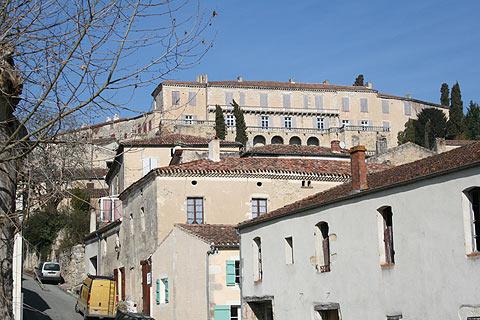
This cozy French village is 1.5 kilometers from our accommodation. It is located in the Landes forest at the confluence of the Gélise and the Gueyze, on the old national road 656 between Mézin and Barbotan-les-Thermes. The village borders the Landes department. The name Sos is derived from pre-Latin, indicating a rocky outcrop.
The Romans called it Sotium or Sotiatum, a reference to the local people, the Sotiates. The Sotiates were one of the subject peoples of Aquitaine and Sos was an important stronghold in Roman times. Current information can be found at https://www.sos-gueyze-meylan.fr

Nérac (25 minute drive)

The medieval and Renaissance town of Nérac, capital of the Albret and located along the banks of the Baïse, captivates the eye with its picturesque charm. Old Nérac therefore forms a particularly harmonious whole thanks to the old houses, the quays and the Gothic bridge that spans the waters of the Baïse. The Rue Séderie with its beautiful half-timbered facades, the Sully House, a Renaissance mansion and the elegant castle museum Hendrik IV are also worth mentioning.
Built from the 14th to the 16th century, the castle of Nérac, former home of the lords of Albret and then residence of the future king Henry IV and his wife Queen Margot from 1577 to 1582, has a Renaissance wing of the lords’ residence preserved, adorned with a splendid gallery. Inside, the visitor will discover a museum dedicated to the Albret family and Henry IV as well as archaeological collections from the Land of Albret.
Lovers of romantic walks will not fail to stroll along the Baïse and past the fountains, statues and centuries-old trees that adorn the charming royal park of the Garenne. nothing better than a traditional boat trip on the Baïse, departing from the port office of the port of Nérac. The traditional market that takes place every Saturday morning, full of colors and scents, is an event not to be missed for lovers of local products. A delight for the palate and the eyes!

Agen (55 minute drive)

Agen is the capital of the Lot-et-Garonne department, in the Aquitaine region and is known for its beautiful historic center.
The current location of the city was inhabited very early in history. Traces have been found that indicate that this area has been inhabited since the Neolithic Age. During the heyday of the Roman Empire, this town grew into a prosperous city. The growth of the city came to a halt after the various invasions of successively the Vandals, the Visigoths and the Franks, who conquered the place in the year 509 AD.
In the first half of the eleventh century AD, the city became part of the county of Aquitaine. This event marked the beginning of a very turbulent period for the city. The place changed hands several times as a result of the Hundred Years’ War. The place was conquered by both the French and the English. From the year 1681, a very prosperous period began for the place, which amassed wealth thanks to trade over the Canal du Midi, which connected the place with both the Atlantic Ocean and the Mediterranean Sea. Partly thanks to this prosperous period, Agen has managed to retain its authentic character over the centuries. Today, this town is known as one of the most beautiful places in the Lot-et-Garonne department.

Bordeaux (90 minute drive)

Bordeaux is located in the southwest of France. It is the capital of the Aquitaine region. The city and its surroundings are famous worldwide for the wine that comes from this region.
In the 3rd century BC, the area around the current city was an area consisting mainly of swamps. Nevertheless, the Romans decided to found the city of Burdigala, now Bordeaux, in this region. The city was located on the Gironde river. In the first century BC, the Romans built numerous structures, such as aqueducts, temples and an amphitheatre. The city would enjoy a prosperous period until the year 409, when the Vandals sacked the city.
The city would eventually be plundered several times. For example, in 414 AD it was the Visigoths who sacked the city, and in 498 the city fell prey to the Franks. Later in the Middle Ages, the city would also be plundered by the Moors and the Normans. Bordeaux came into English possession in 1154 when Eleanor of Aquitaine married Henry II of England. The city then went through a period of prosperity, partly thanks to the wine trade. Only at the end of the Hundred Years’ War between France and England did the city come into French possession. In the nineteenth century, the city experienced considerable growth due to the rail connection with Paris and the large industries that settled in the city. Partly because of this, the city would eventually grow into Bordeaux as we know it today.
Today, Bordeaux is a city with plenty to see and experience. An important landmark in the city is the Pont de Pierre, the bridge over the river Garonne. Another attraction is the Place des Quinconces, which is known as the largest square in France. There is also the old town, where there are numerous shops and restaurants, as well as the Grand Théâtre and the impressive opera house. Finally, there are many museums in the city, such as the Musée d’Aquitaine. This is a museum about the history of Aquitaine, where Roman remains are exhibited, among other things. Bordeaux is a beautiful city that is definitely worth a visit.

Toulouse (105 minute drive)

Toulouse is a city located in the Haute-Garonne department, and is the capital of the Midi-Pyrénées region. The city is located on the river Garonne. Based on the number of inhabitants, Toulouse is the fourth largest city in France.
The history of the city began about 2000 years ago. A small group of Celts settled near the river Garonne. During the heyday of the Roman Empire, the Romans founded a small settlement here. This settlement went through a period of prosperity. Barely 100 years after the Romans founded the settlement, a large wall was already built around it. However, this large wall could not prevent the settlement from being plundered several times by barbarian tribes. In the Middle Ages, the settlement grew in status. The settlement had meanwhile grown into a city, and was declared the capital of the County of Toulouse. A period of religious unrest followed.
In the twelfth century, the Cathars tried to establish a community in the city, but were driven out by the armies of Simon de Montfort. The fourteenth century can be seen as a black page in the history of this city. First the city had to deal with the plague. This deadly disease claimed many victims among the civilian population of Toulouse. After the Plague, the city suffered the effects of the Hundred Years’ War, and several floods. It was not until the fifteenth century that better times began. Toulouse benefited from trade, and the city became increasingly wealthy. This period of prosperity would come to an end in the sixteenth century, partly due to the outbreak of various diseases.
Today, Toulouse is a city where traces of the past are still clearly visible. In the city there are many interesting historical sites, such as the Capitole, the Pont Neuf and the Canal du Midi. There are also many museums in the city, from the Museum of Fine Arts to the Musée du Vieux Toulouse, about the history of the city. A special attraction is the Basilica of Saint-Sernin. This is the largest Romanesque church in Europe. Finally, the city center of this place is also very cozy. There are countless nice terraces to be found, and there are plenty of shops to enjoy shopping.


